SAT vs. ACT: Which Test Should You Take?
A Side-by-Side Comparison to Help You Choose the Right College Entrance Exam
Aiden Kjeldsen • September 20, 2025 • 6 min read
What is SAT and What is the ACT?
Before the 1900s, many colleges relied on their own aptitude or intelligence tests to decide who was eligible for admission. There was no standardization. Each university had its own exam making the process confusing and inconsistent for students.
To address this, a group of prestigious institutions—including Columbia, Cornell, and Harvard—came together to form the College Entrance Examination Board, a nonprofit organization with the goal of centralizing and standardizing the admissions testing process.
The SAT (Scholastic Aptitude Test) eventually emerged from this effort, designed to measure students’ reasoning and problem-solving abilities. But not everyone agreed with this approach.
In 1960, a professor in Iowa introduced the ACT (American College Testing) as an alternative. Unlike the SAT, the ACT focused more on curriculum-based learning—in other words, it tested what students were actually being taught in school, rather than abstract reasoning.
Today, both the SAT and ACT are accepted by most U.S. colleges—but they have different formats, scoring systems, and skill focuses. (More on that in the next section!)
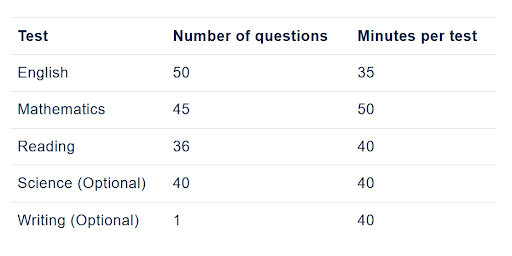
This is the breakdown of the ACT!
The ACT:
So here we begin with the ever popular in the midwest and east coast is the ACT. The ACT is an achievement-based college admissions exam that focuses on what students have actually learned in school. If you like a straightforward assignment then the ACT’s is right for you. And if you work better under time pressure and are more STEM focused than these are another few reasons to like the ACT.
Test Format and Timing
The ACT consists of 215 multiple-choice questions divided into four main sections where each section only accounts for 25% of your score:
- English
- Math
- Reading
- Science
The full test takes around 3 hours and 30 minutes to complete (including a short but needed break). The Actual testing time (not including breaks) is 2 hours and 55 minutes
There’s also an optional writing section (essay), which adds an additional 40 minutes if selected. Some colleges require it, but many do not.
The is quite simple Scoring:
- Each section is scored on a scale of 1 to 36
- Your composite score is the average of your four section scores, also on a 1–36 scale
- The optional writing section is scored separately
The SAT:
Now here we go into the popular West Coast college gatekeeper in the SAT. The SAT is a reasoning-based college admissions exam, originally designed to measure how well you can think critically and apply knowledge in unfamiliar ways. If you're someone who prefers logic puzzles, pattern recognition, and slightly more time per question, the SAT might feel like a better fit!
Test Format and Timing
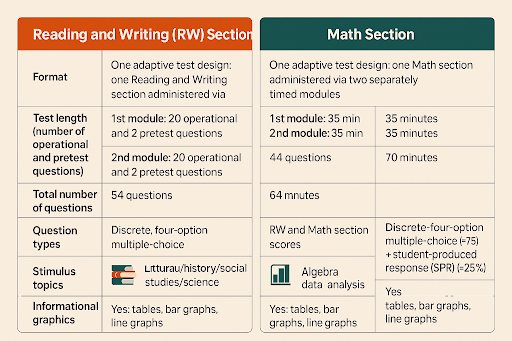
The SAT is now adaptive, meaning the test adjusts its difficulty based on how you perform during the first section of each subject. It’s divided into two main sections:
- Reading & Writing
- Math
Each section is split into two modules. You’ll answer easier questions in the first module, and based on your performance, the second module will become more or less challenging.
The full testing time is just under 2 hours and 15 minutes!
Scoring
- Each section is scored on a scale of 200 to 800
- Your total SAT score is the sum of both sections, with a maximum score of 1600
- There’s no essay section on the SAT
The SAT leans slightly more toward reading comprehension and logical reasoning, especially in its math and verbal sections. There’s also less time pressure per question compared to the ACT, which some students find helpful.
But truly the only reason why someone would prefer the SAT is the ample amount of Free testing resources.
Study Resources:
So as mentioned above, the SAT I think has much better study materials than the ACT by a pretty decent margin. But this is when it comes to free resources, so if you plan to pay then they are about equal.
The SAT stands out largely because of its partnership with Khan Academy. It has free, personalized study plans based on your PSAT or SAT scores, Full-length practice tests, Step-by-step math tutorials Reading and writing drills modeled directly after SAT questions. So it is quite useful! There are also tons of youtube videos and free Practice tests online. The SAT test partner Bluebook also has free, self-guided test preparation questions and full-length practice exams.
The ACT on the other hand has limited free resources that lack depth. The platform includes: One free full-length practice test, A few subject-specific question sets, and basic study tips and general advice.
Now when It comes to paid resources the best study books I recommend are the SAT or ACT study panda book and for online resources the Kaplan SAT or ACT prep is great.
If you want to do the 100% free route then the SAT is the right test for you.
Testing Day:
The day has arrived! Make sure you have everything ready: your printed admission ticket, a valid photo ID, two No. 2 pencils, an approved calculator, and some snacks and water for the break. Wear comfortable clothes and set an early alarm to avoid rushing.
Arrive at your testing center early—doors typically close around 8:00 a.m., and late arrivals aren’t allowed to test. Once seated, listen carefully to instructions and stay calm. You've put in the work, and now it's just about pacing yourself. The SAT allows a bit more time per question, while the ACT moves faster, especially in the reading and science sections. If a question stumps you, move on and come back later if there’s time.
During the break, step outside if allowed, eat a quick snack, and hydrate. Once you’re done, take a breath. SAT scores usually come out in two to three weeks, and ACT scores in about ten to fourteen days. Review your results when they’re released and decide whether to send them, retake the test, or move forward with your applications.