How to Get Into Stanford University: Admission Tips, Acceptance Rates, and What Stanford Looks For in 2025
Learn how to get into Stanford University in 2025. Complete guide covering acceptance rates, GPA requirements, SAT/ACT scores, essays, and proven strategies to strengthen your application.
Aiden Kjeldsen • October 24, 2025 • 8 min read
Understanding Stanford's Selectivity
Stanford University remains one of the most prestigious and selective institutions in the United States. It combines rigorous academics, a stunning Silicon Valley campus, elite Division I athletics, and a network of distinguished alumni—spanning tech founders like the creators of Google and Instagram, Supreme Court Justices, astronauts, Pulitzer Prize-winning authors, groundbreaking inventors, and even a U.S. President.
But with that prestige comes intense competition. Stanford's acceptance rate hovers around 3.6–3.9%, making it one of the hardest universities in the world to get into. With tens of thousands of applicants competing for roughly 1,700 spots, understanding what Stanford values is crucial to crafting a competitive application.
If Stanford is your dream school, here's what current data reveals about Stanford admission requirements, what the admissions committee prioritizes, and specific strategies to maximize your chances of acceptance.
Academic Profile of Recent Stanford Admits
To understand what you're competing against, here's the academic profile of recently admitted students:
GPA Requirements
- Average GPA: ~3.95 (unweighted)
- About 94% of admits earned a 3.75 or higher
- Nearly 96% graduated in the top 10% of their high school class
SAT and ACT Scores
- SAT Middle 50%: 1500-1570
- ACT Middle 50%: 33-35
Rigorous Coursework
- Most admitted students completed 8-12+ Advanced Placement (AP), International Baccalaureate (IB), or dual-enrollment courses
- Demonstrates ability to handle college-level work
Important 2025 Update
Stanford will reinstate the required SAT/ACT submission starting with the Fall 2026 application cycle. Students applying for the Class of 2029 and beyond should plan to submit strong standardized test scores. For more details, visit Stanford's official admissions website.
What Does Stanford University Look For?
Since nearly all Stanford applicants are academically excellent, the admissions committee looks deeper than just grades and scores. According to Stanford's Common Data Set, here are the factors considered in application review:
Very Important Factors:
- Rigor of secondary school coursework
- Class rank
- Grade point average (GPA)
- Standardized test scores (returning as mandatory)
- Application essays
- Teacher and counselor recommendations
Important Factors:
- Extracurricular activities
- Talent and ability
- Character and personal qualities
Considered:
- Alumni/ae relation (though California banned legacy admissions beginning in 2025)
- First-generation college student status
- Interviews (when available)
- Volunteer work and community service
- Work experience
Not Considered:
- State residency
- Religious affiliation
- Level of applicant's interest
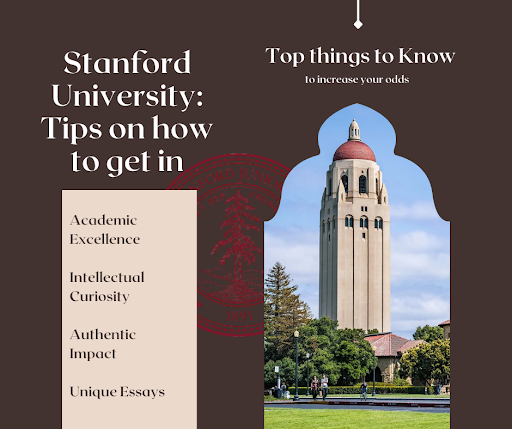
The Four Pillars of a Strong Stanford Application
1. Academic Excellence
Your grades, test scores, and course selection form the foundation of your Stanford application. Stanford seeks students who are intellectually prepared to thrive in one of the nation's most rigorous academic environments.
Action Steps:
- Target a 3.9+ unweighted GPA throughout high school
- Aim for a 1540+ SAT or 34+ ACT to be competitive
- Enroll in the most challenging courses available at your school—honors, AP, IB, or dual enrollment
- Demonstrate consistent academic performance across all subject areas
Selective colleges like Stanford use tools like the Academic Index (a formula combining GPA and test scores) to initially filter applicants. Strong academics keep you in consideration, but they won't guarantee admission on their own.
2. Intellectual Curiosity
Stanford students are defined by their genuine love of learning and innovation. The admissions committee looks for applicants who pursue knowledge and ideas beyond classroom requirements—students who ask "why" and "what if?"
Ways to Demonstrate Intellectual Curiosity:
- Conduct independent research in areas that fascinate you
- Lead or actively participate in academic clubs, competitions, or olympiads
- Secure internships or mentorships with professors, researchers, or industry professionals
- Launch independent projects that explore questions you care about
- Start community initiatives that apply your learning to real-world problems
- Take online courses or attend summer programs in subjects that excite you
Ask yourself: "How do I spend my free time in ways that energize and fulfill me intellectually?"
3. Authentic Impact
Stanford seeks future leaders and changemakers who use their skills, character, and passion to make a meaningful difference in their communities and beyond. Admissions officers strongly prefer depth over breadth...
Examples of Authentic Impact:
- Founding a nonprofit or social initiative that addresses a genuine need
- Leading teams in sports, performing arts, debate, STEM competitions, or student government
- Sustained volunteering in areas connected to your personal values and experiences
- Collaborating with others to solve real problems in creative ways
- Creating measurable change through your efforts—lives touched, funds raised, awareness generated
Admissions officers strongly prefer depth over breadth. A few long-term commitments showing leadership, growth, and genuine impact will always outweigh a scattered resume of superficial activities joined for college applications.
4. Compelling Essays
Stanford's supplemental essays are famously personal, open-ended, and critical to your application success. Your essays provide the opportunity to connect your academic achievements and extracurricular record to your values, personal journey, and future potential.
Stanford's Required Essays Typically Include:
- An idea, experience, or topic that excites your intellectual curiosity
- A note to your future Stanford roommate
- What is meaningful to you and why
- Additional short answers about your activities and life
Essay Writing Tips:
- Share specific, vivid stories that reveal your character and perspective
- Be authentic—admissions officers can spot manufactured narratives
- Highlight your core values and what drives you
- Show growth and self-reflection—how have you evolved?
- Demonstrate how you'll contribute to the Stanford community
- Avoid clichés, generic statements, and what you think they want to hear
Stanford weighs essays extremely heavily: compelling, genuine essays can elevate your application, while generic or poorly executed essays can undermine otherwise strong credentials.
Additional Success Factors
Recommendation Letters
Stanford requires three letters of recommendation:
- One from your school counselor
- Two from teachers (preferably in core academic subjects)
- One optional additional recommendation
Strong letters should:
- Provide specific examples of your intellectual curiosity
- Discuss your character, leadership, and impact in the classroom
- Offer insights admissions officers can't get from other parts of your application
Choose recommenders who know you well and can speak authentically to your strengths and growth.
Restrictive Early Action (REA)
Stanford offers Restrictive Early Action with a November 1 deadline. While not binding (you can apply to other schools later), REA applicants historically have shown higher acceptance rates — though this may partly reflect self-selection of highly qualified candidates.
REA is a good choice if:
- Stanford is genuinely your top-choice school
- Your application is strongest by November (grades, test scores, activities are solid)
- You want an admissions decision by mid-December
Understanding Extracurricular Tiers
Not all activities carry equal weight. Stanford evaluates extracurriculars on a tier system:
- Tier 1: Exceptional, rare accomplishments (national/international recognition, major awards)
- Tier 2: Significant leadership or state/regional-level recognition
- Tier 3: Solid participation and school-level leadership
- Tier 4: Common activities without significant distinction
Competitive applicants typically have one or two Tier 1-2 activities that demonstrate their "spike"—the area where they truly excel and stand out.
Stanford's Student Body Snapshot
Understanding Stanford's student demographics provides insight into the university's commitment to diversity.
Ethnic and Racial Composition:
- Asian: ~33%
- White: ~24%
- Hispanic/Latino: ~15%
- Black/African American: ~8%
- International students: ~14%
- Multiracial and other backgrounds: ~6%
Geographic and Educational Background:
- Students represent all 50 U.S. states and 70+ countries worldwide
- 56% graduated from public high schools
- 28% from private schools
Frequently Asked Questions About Stanford Admissions
- what does Stanford look for in applicants? Stanford uses a holistic admissions process evaluating academic excellence, intellectual curiosity, meaningful extracurricular impact, compelling essays, strong recommendations, and personal character. They seek students who will contribute to and benefit from Stanford's diverse community.
- does Stanford consider demonstrated interest? No, Stanford does not track or consider demonstrated interest in admissions decisions.
- what is Stanford's Restrictive Early Action program? REA is a non-binding early application option with a November 1 deadline. If admitted, you are not required to attend, but you cannot apply early to other private universities.
- What majors is Stanford known for? Stanford excels across disciplines but is particularly renowned for Computer Science, Engineering, Business, Economics, Biology, Political Science, and interdisciplinary programs.
- Can international students get into Stanford? Yes, international students comprise about 14% of each incoming class. International applicants follow the same application process and are evaluated by the same holistic standards as domestic applicants.
- What is Stanford looking for in essays? Stanford seeks authentic, reflective essays that reveal your personality, values, intellectual curiosity, and how you'll contribute to campus. They want to understand your voice, perspective, and what makes you unique.
Final Thoughts: Your Path to Stanford
With acceptance rates around 3.6-3.9%, Stanford University stands among the most selective universities in the world. Almost every applicant brings stellar grades and impressive test scores—the real differentiators are your intellectual curiosity, meaningful impact, and authentic story.
By combining academic excellence, genuine intellectual passion, deep extracurricular involvement, and compelling personal essays, you'll position yourself as strongly as possible for Stanford admission.
Remember that admission to Stanford—or any highly selective university—is never guaranteed, no matter how qualified you are. Focus on becoming the best version of yourself, pursuing what genuinely excites you, and applying to a balanced list of schools where you can thrive.